I recently read an article on the BBC site. It was about reviving closed school buildings into unique inns in rural Japan. The young population started moving to the cities after Japan’s postwar economic boom. Every year, about 450 rural schools close as there are no children to come, sit and study.
Around the world, the percentage of the population living in rural areas is declining. The share of the urban population is increasing. In 1960, 66% of the world’s population lived in villages. In the year 2024, only 42% of the world’s population resided in rural areas. The move towards towns and cities is generally driven by economic opportunities and aspirations. Better infrastructure in urban areas helps drive this trend. Other factors include conflicts, national-level policies, and personal reasons & preferences.
The World Bank classifies countries into five types of economy based on Gross National Income (GNI) Per Capita. These classifications are: (1) High-Income Countries, (2) Upper-Middle-Income Countries, (3) Middle-Income Countries, (4) Lower-Middle-Income Countries, and (5) Low-Income Countries. The graph illustrates the percentage of the population living in rural areas across various economic types in 1961 and 2024.
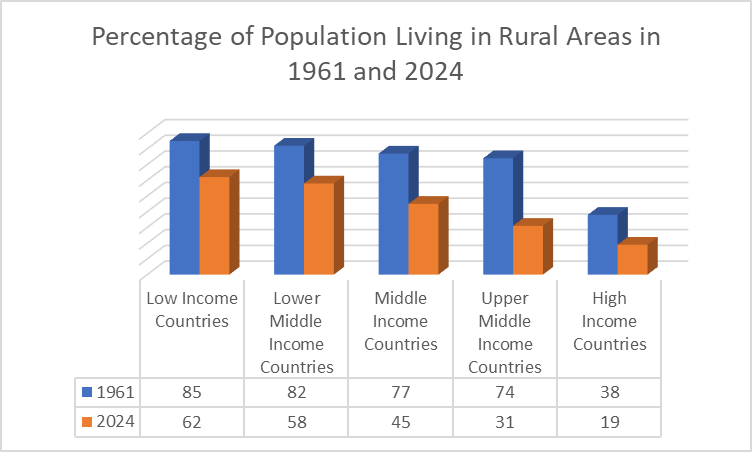
In 1961, more than 70% of the population were rural dwellers, except in the high-income countries. The shift from rural to urban dwelling is more pronounced in middle-income countries, with a change of 32%. It is even higher in upper-middle-income countries, with a change of 43%. This change is lower in low-income (23%) and lower-middle-income (24%) countries. There is no universal definition of urban area. Different countries have their own criteria for urban areas. In 1990, the world had 1358051.091 square km of land considered as urban land and in 2015, the urban area was 1899243.725 square km. The land under urban areas is also increasing.
More urban dwellers and higher Per Capita Income are signs (to an extent) of prosperity and better infrastructure. On the other hand, this trend also indicates fewer livelihood opportunities and poor infrastructure in rural areas compared to urban areas. If this trend continues, then there is a possibility of too few people staying in the rural areas across the world. In such a case, agriculture will go through structural changes (in local contexts). These structural changes will impact the most basic aspect of humans, food, positively or negatively.
(Views are personal.)
 Sustainability Insights
Leave a comment