One of the major challenges our planet is facing is global warming and climate change. The increasing temperature and change in precipitation levels & seasons impact our day-to-day life and food production. Many natural disasters are linked to the changing climate and increasing global temperature. The major cause of global warming is attributed to greenhouse gases. These gases trap heat in the atmosphere. Burning of fossil fuels (coal, oil, and natural gas) for energy and heat generation produces most of the greenhouse gases. There are other causes of increasing greenhouse gases, like reducing forest cover, the use of fertilisers, untreated landfills and livestock. (Source: EPA)
There are four greenhouse gases – Carbon Dioxide, Methane, Nitrous Oxide, and F-Gases. Other greenhouse gases are ground-level ozone, water vapour and Aerosols. Greenhouse gases in the earth’s atmosphere are about 80% carbon dioxide and 11% Methane.
The lifespan of a methane molecule is 7 to 12 years, while Carbon Dioxide remains in the atmosphere for hundreds of years. A molecule of Methane (CH4) traps more heat than carbon Dioxide (CO2). The impact of one tonne of methane on global warming, considering a 100-year timeframe, is equivalent to 28 to 36 tonnes of CO2. This potential is 80 times more than CO2, considering 20-year timeframe.
Approximately 60% of methane emissions occur through human activities, including agricultural practices, waste decay in landfills, and fossil fuel production & distribution. The remaining 40% of methane is emitted naturally, primarily through wetlands. The concentration of methane is increasing in the atmosphere. In January 1984, the concentration of methane was 1638.74 parts per billion. This concentration increased to 1934.91 parts per billion in April 2025.
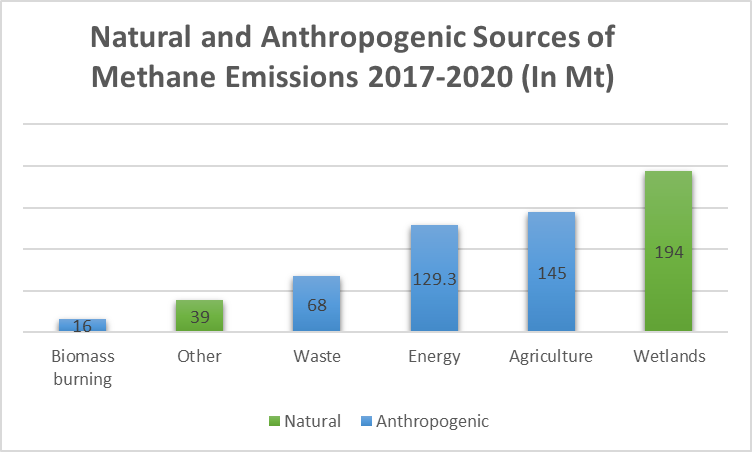
The International Energy Agency (IEA) presented the sources of methane emissions for the years 2017-2020. Agriculture is the major source of methane. The Energy (primarily oil, gas and coal) is the second largest source of methane emissions. Methane emissions in the energy sector are mostly due to leakage from the trapped methane. Methane emissions from agriculture, energy, waste and biomass burning are mostly considered as anthropogenic, i.e., due to human activities.
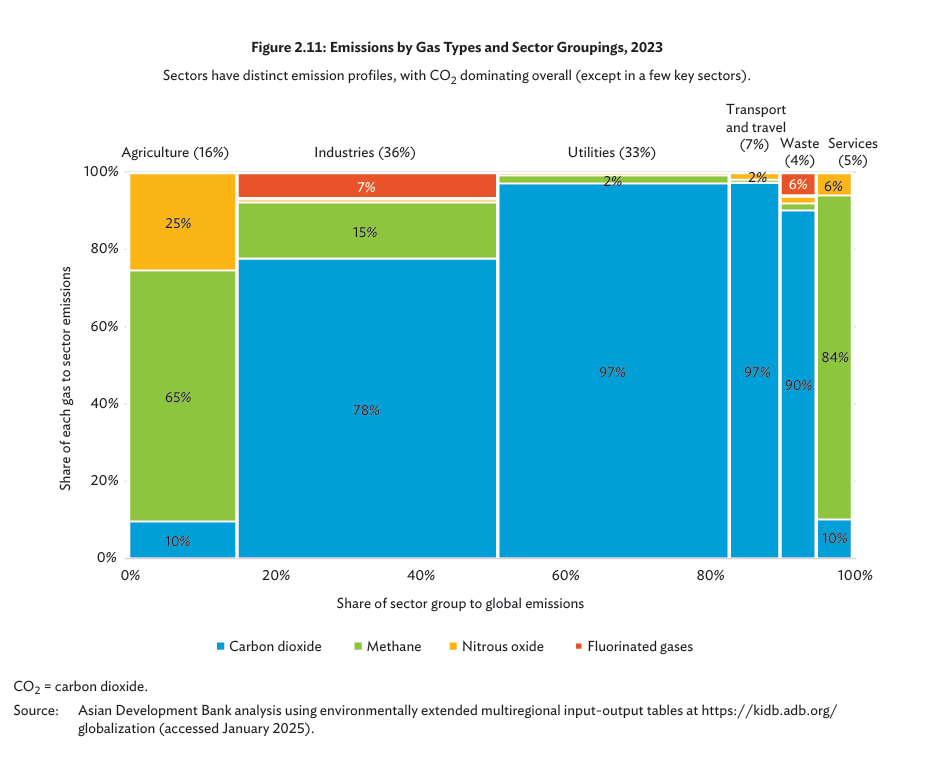
The Asian Development Bank (ADB) presented an integrated graph of greenhouse emissions by different sectors in a recent publication. Please refer to the figure below. In 2023, agriculture contributed only 16% of the total emissions of greenhouse gases. Emissions from agriculture included 65% of Methane, 25% of Nitrous Oxide and 10% Carbon Dioxide. Agriculture includes cultivation, hunting, forestry, and fishing (in the report).
The reports argue that reducing methane molecules from the atmosphere will impact global warming. Methane molecules have a higher potential to trap heat than carbon dioxide. IEA reports that oil and gas operations are the largest source of emissions in the energy sector. The same report estimates that around three-quarters of today’s methane emissions from global oil and gas operations can be avoided. This can be done with no significant cost.
International Fund for Agricultural Development (IFAD) runs the Reducing Agricultural Methane Programme (RAMP). The programme provides knowledge and technical support for reducing methane emissions. Most of the methane in agriculture is from enteric fermentation, manure management and flooded rice cultivation.
Methane is a greenhouse gas, less talked about than carbon dioxide. Reports have suggested that there is scope for managing the anthropogenic emissions of methane. At the end, sustainability seeks to create a balance between the environment and development. Food security remains the first concern.
(Views are personal.)
 Sustainability Insights
Leave a comment